
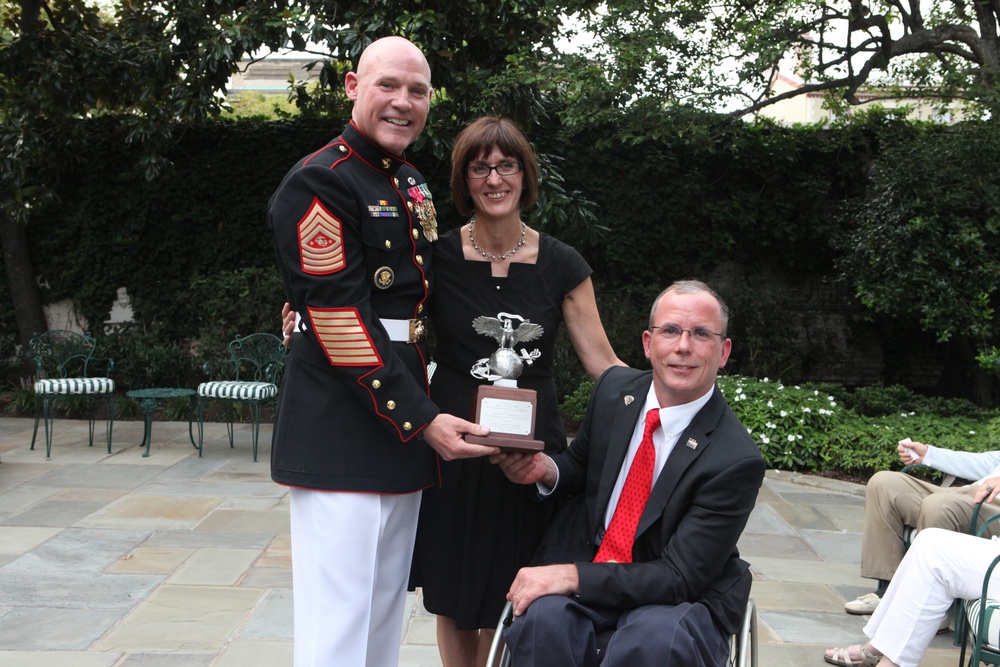
Photo By Cpl. Cody Fodale | From left, Sgt. Maj. of the Marine Corps and Evening Parade host, Micheal P. Barrett;...... read more read more
 Subscribe
SAN ANTONIO, Texas – June 18, 2026 – The sound of cheering filled the competition venue as Team Army pushed, pedaled, lifted and competed through another day of the 2026 Warrior Games.
For Dr. Rory Cooper and his wife, Rosi, the scene was more than athletic competition. It was familiar. It reflected a recovery journey they have lived, supported and helped shape for others for decades.
An Army veteran, adaptive sports competitor and biomedical engineer, Cooper’s own path began in uniform, continued through injury and adaptive sports, and eventually led to a career focused on improving wheelchair technology and expanding mobility for people with disabilities. Watching Team Army competitors compete at the Warrior Games, he said, is both motivational and rewarding because he sees adaptive sports as part of a larger recovery pathway.
“This is part of their recovery,” Cooper said. “Hopefully, they’ll use this to develop skills so they can participate in sports and recreation for a lifetime, stay healthy, stay connected to their family and community.”
The Army Recovery Care Program supports wounded, ill and injured Soldiers as they recover and prepare for their next chapter, whether that means returning to duty, transitioning from service or finding renewed purpose beyond uniform. At Games, that mission is visible through Team Army competitors who rebuild through adaptive sports.
Through ARCP, adaptive sports are part of a broader recovery process that helps Soldiers rebuild confidence, connection and purpose, and for Team Army the Games gives their recovery mission a visible stage.
For Cooper, adaptive sports helped him rediscover an important part of himself after his injury. As a former high school athlete and Soldier who valued physical fitness, he said adaptive sports allowed him to bring movement, competition and purpose back into his life.
“After I was injured, adaptive sports let me rediscover that part of myself,” Cooper said. “I was able to integrate that back into my life.”
Cooper’s journey reflects what ARCP works to support every day: recovery that continues beyond treatment and helps Soldiers move toward what comes next.
His recovery didn’t end with learning how to live after injury. It became the foundation for a career focused on helping others move with greater independence. As a biomedical engineer, Cooper used his lived experience as a Soldier and wheelchair user to improve mobility technology and advocate for greater access.
When he was first injured, Cooper said wheelchair technology wasn’t as functional or innovative as it is today. As his engineering knowledge grew, he saw the need for equipment that better matched the person, the sport and the purpose.
“When I first started, the wheelchairs people saw in the hospital were also the wheelchairs we used and competed in,” Cooper said. “That just didn’t make any sense to me, especially as I advanced in my engineering knowledge.”
At the Warrior Games, adaptive equipment is visible in nearly every venue. Competitors rely on wheelchairs, bikes, prosthetics and other equipment designed to support movement, performance and safety. His work in mobility technology gives deeper meaning to the competition unfolding around him, where access, equipment and support help make participation possible.
According to Cooper, advances in technology, coaching, training and medical knowledge have helped reduce injuries and expand what’s possible for competitors with different levels and types of impairment.
“Through technology, we have all these sports in the Warrior Games, plus a whole range of other sports that people can participate in,” Cooper said.
For Cooper, seeing adaptive sports continue to grow within military recovery programs is meaningful because it gives wounded, ill and injured service members a pathway for a lifetime.
“It’s highly meaningful for me to see that we still have adaptive sports in these programs,” Cooper said.
The impact reaches beyond the competitor. Cooper said adaptive sports can also strengthen families by allowing loved ones to see their Soldier competing, having fun and reconnecting with parts of themselves that may have seemed lost after injury or illness.
That family connection is personal for the Coopers. Rosi met Cooper in Germany while he was serving in the Army. She knew him as a runner and athlete before his accident, saw him in the hospital afterward and later watched him rebuild his life through recovery, sport and service.
For Rosi, watching families at the Warrior Games brings back memories of her own experience.
“When I watch the families, I reflect on my own life, when I thought, ‘What now?’” Rosi said.
Rosi said seeing families cheer for their loved ones reminds her that recovery can be emotional, uncertain and deeply personal. It can also reveal that while life may change after injury, the person at the center of that recovery remains.
Rosi’s perspective adds the family side of recovery, a reminder that healing is often sustained by the people who walk beside the Soldier long after the initial injury, illness or diagnosis.
She said one of the most important things she wants families to understand is that support doesn’t erase identity. Spouses and loved ones may support recovery, but they shouldn’t be reduced only to the role of caregiver.
“I’m still his wife,” Rosi said. “Your identity shouldn’t get lost because you’ve now taken on the role of caregiver.”
Recovery can require patience, adjustment and commitment from the service member, and those closest to them, but Rosi said it can still be approached as a team.
“Rory and I still do this as a team,” Rosi said. “He has to give to it, and I have to give to it.”
For Rosi, the Warrior Games are also meaningful because they allow newly wounded, ill and injured service members, families and the larger community to see what’s possible. She said the Games benefit not only the competitors, but also the people watching from the stands and the communities that host them, reminding them there is light at the end of the tunnel.
For Cooper, the greatest part of being at the Games is connecting with competitors, families and coaches, and sharing stories about what life can look like after injury.
“The thing I look forward to most is connecting with the competitors and talking about our life experiences,” Cooper said. “One of the advantages is learning we have a lot more similarities than we do differences.”
The ARCP helps Soldiers recover with purpose, Warrior Games shows that purpose in motion and Cooper’s life shows how far that purpose can reach.
For Cooper, Rosi and Team Army, the Warrior Games are a reminder that recovery doesn’t end when treatment does. With support, movement and purpose, it can become a new way to serve.
| Date Taken: | 06.18.2026 |
| Date Posted: | 06.18.2026 22:24 |
| Story ID: | 568190 |
| Location: | SAN ANTONIO, TEXAS, US |
| Web Views: | 348 |
| Downloads: | 0 |

This work, From Recovery to Innovation: Dr. Rory Cooper’s Army Journey Reflects ARCP Mission, by Vernishia Vaughn, identified by DVIDS, must comply with the restrictions shown on https://www.dvidshub.net/about/copyright.


No keywords found.




